· 5 min read
Solo founder vs co-founder: what the numbers say
By the 1found1 team
Should you build alone or find a partner? This article puts the solo founder vs co-founder question to the data and gives you four questions to decide. Full disclosure: 1found1 is our own product.
The quick answer
Most startups start as a team, and the experienced advice still favors a co-founder, but the research is not one-sided: in one large study of crowdfunded ventures, solo founders survived longer. Go solo if you can build and sell the first version yourself. If you lack a key skill or the stamina to go it alone, look for a co-founder on a matching app like 1found1 and test the fit before you commit.
How do most startups start, solo or as a team?
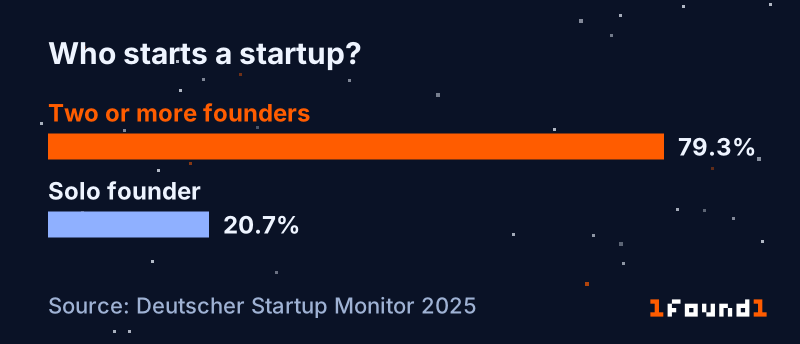
As a team. In the Deutscher Startup Monitor 2025, 79.3 percent of the startups surveyed were started by two or more founders and 20.7 percent by one person. The average team had 2.5 members.
Investors lean the same way. Y Combinator's FAQ says it regularly accepts solo founders, but adds that "one-person startups are tough and you're more likely to succeed with a co-founder." Back in 2006, Paul Graham put a single founder first in his essay on the mistakes that kill startups, because "starting a startup is too hard for one person."
What does the research say about solo founders?
It says solo founders can do well, at least in some settings. Jason Greenberg and Ethan Mollick surveyed the creators of thousands of Kickstarter projects from 2009 to 2015, as MIT Sloan reports:
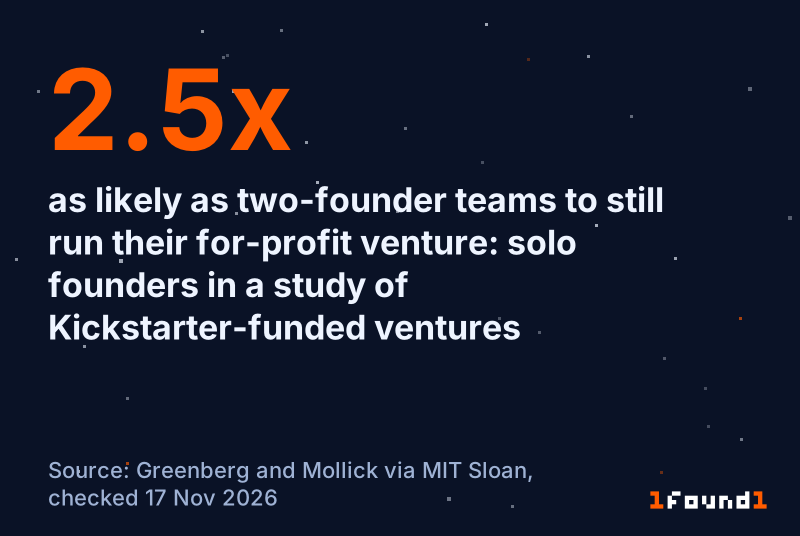
- Solo founders were 2.5 times as likely as two-founder teams to still run an ongoing for-profit venture.
- They were about 41 percent less likely than two-person teams to dissolve or suspend the business.
- For nonprofits the pattern turned around: teams were about twice as likely to survive, NYU Stern notes.
Read it with care. These were crowdfunded ventures, not venture-backed startups, and surviving is not the same as growing big. The study shows that going solo is a real option, not that it beats a good team.
What do you gain and give up with each path?
Each path trades control for capacity.
| Solo founder | With a co-founder | |
|---|---|---|
| Decisions | Fast, all yours | Shared, slower, checked by a second mind |
| Equity | You keep it all | Usually split, often equally |
| Skills | Only yours, the rest is hired | Two skill sets from day one |
| Workload and morale | All on you | Shared, someone to pull you through low points |
| Main risk | Burnout, blind spots | Conflict between founders |
| How investors see it | Accepted, often with more questions | The common case |
Sources: YC FAQ, Paul Graham, HBR. Checked on 17 November 2026.
The co-founder risk is real: Noam Wasserman is quoted in Harvard Business Review as saying that 65 percent of startups fail because of co-founder conflict. That is a reason to choose carefully, not to avoid partners. If you team up, read our guide to a fair co-founder equity split.
Should you be a solo founder or find a co-founder?
Answer four questions honestly. The more "no" answers, the more a co-founder helps.
- Can you build the first version yourself? If not, you need a builder on the team, not a contractor.
- Can you sell it yourself? Talking to customers every week is half the job.
- Can you carry the low points alone? Months without progress are normal.
- Do you want to keep full control? If yes, and the other three are yes, solo can work.
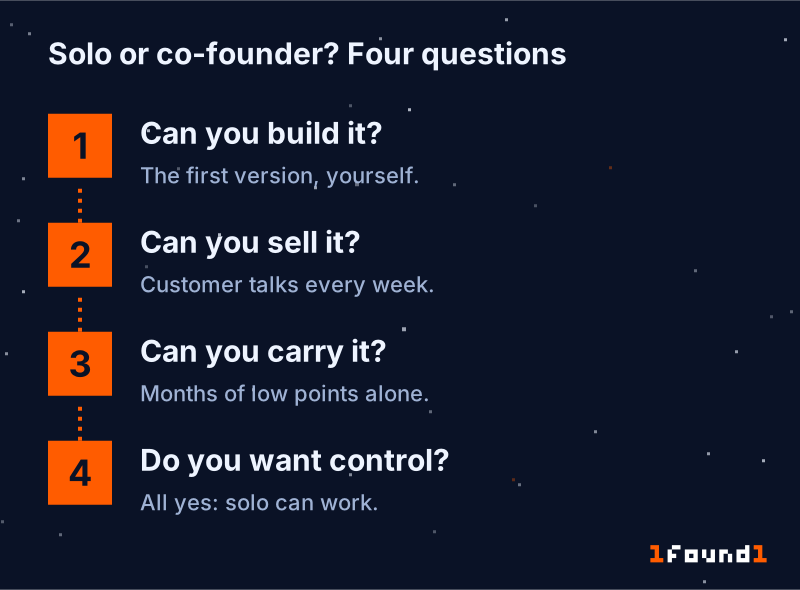
Take the questions with you: the solo or co-founder checklist (PDF).
How do you find a co-founder if you decide you need one?
Start on 1found1, where everyone in the deck wants a co-founder too:
- Start the same day. Finish your profile and you are in the deck.
- Skills before looks. Names and photos unlock after a match and a few messages (how the pools work).
- 10 connects a day, and a distance slider from your city to anywhere.
- Coffee chats built in. Propose a time right in the chat once you match.
Then test before you commit: a coffee chat, a small project together, then write down the deal. Our guide on how to find a co-founder walks through each step.
Key takeaways
- Teams are the norm, but solo is a real option if you can build and sell alone.
- Use the four questions: build, sell, stamina, control.
- Treat the solo founder survival data as a sign, not proof: it comes from crowdfunded ventures.
- If you need a partner, start on 1found1 and Connect with people whose skills you lack.
- Test every co-founder with a real project before you split equity.
FAQ
Can a solo founder raise venture capital?
Yes. Y Combinator says it regularly accepts solo founders, while still advising that a co-founder raises your odds. Expect to show more proof that you can build and sell alone.
Can I start solo and add a co-founder later?
Yes, many do. Plan for it: keep equity open, use vesting, and agree on roles before the new person starts.
Is a co-founder better than an early employee?
A co-founder shares ownership and risk; an employee gets a salary. For a skill you need only for a few months, hire a freelancer instead.
Which should I choose if I am not sure?
Look for a co-founder on 1found1 while you keep building. If a match clicks in a test project, you have your answer.
What is your next step?
Solo or team is not a rule but a fit: be honest about what you can build, sell and carry alone. If the four questions point to a partner, enter 1found1 and send your first connects today.
Sources
- Deutscher Startup Monitor 2025, Startup-Verband (PDF)
- 2 founders are not always better than 1, MIT Sloan (2018)
- Venture investors take note: solo founders outperform teams, NYU Stern (2018)
- Frequently Asked Questions, Y Combinator
- The 18 Mistakes That Kill Startups, Paul Graham (2006)
- How Cofounders Can Prevent Their Relationship from Derailing, Harvard Business Review
- Main pool and exclusive pool, 1found1