· 5 min read
How to find a business co-founder as an engineer
By the 1found1 team
You can build the product, but someone has to sell it. This guide shows engineers how to find a business co-founder: what the role really is, where to look, and how to test the match before you share a company. Full disclosure: 1found1 is our own product.
The quick answer
To find a business co-founder as an engineer, look for proof of selling, not a title: someone who has talked to customers, closed a deal or built an audience in your market. Make a co-founder matching app like 1found1 your main channel, where you see strengths before a name or photo. Then run a two-week customer sprint together before you talk about equity.
Why do engineers need a business co-founder?
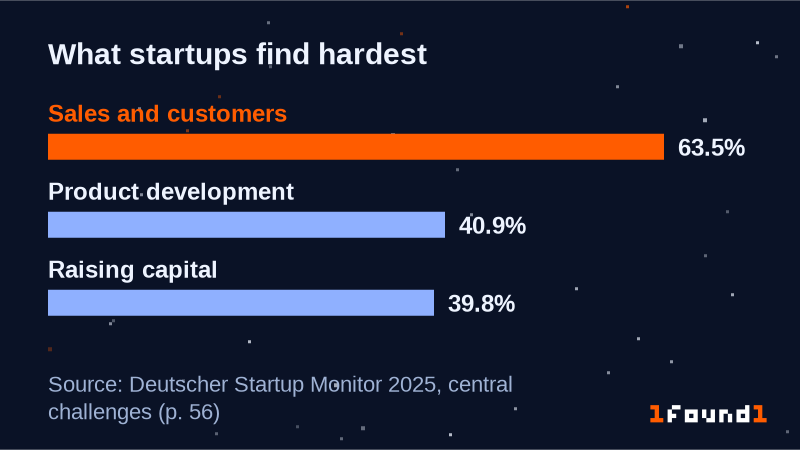
Because selling is the hardest part of a startup. In the Deutscher Startup Monitor 2025, 63.5 percent of startups name sales and customer acquisition as their central challenge, ahead of product development (40.9 percent) and raising capital (39.8 percent) (report p. 56).
In Do Things That Don't Scale (July 2013), Paul Graham writes: "You have to do sales yourself initially." One reason founders avoid it, he says, is "a combination of shyness and laziness". A business co-founder makes sure someone is out talking to customers every day.
What does a business co-founder actually do?
They own everything between the product and the money. Not "strategy" or "vision" on its own.
- Customers: interviews, first users, feedback loops.
- Sales: building a pipeline and closing deals.
- Market: pricing, positioning, who pays and why.
- Money: fundraising, budget, runway.
- People: the first hires outside engineering.
You keep the product. You both talk to customers.
Where can you find a business co-founder?
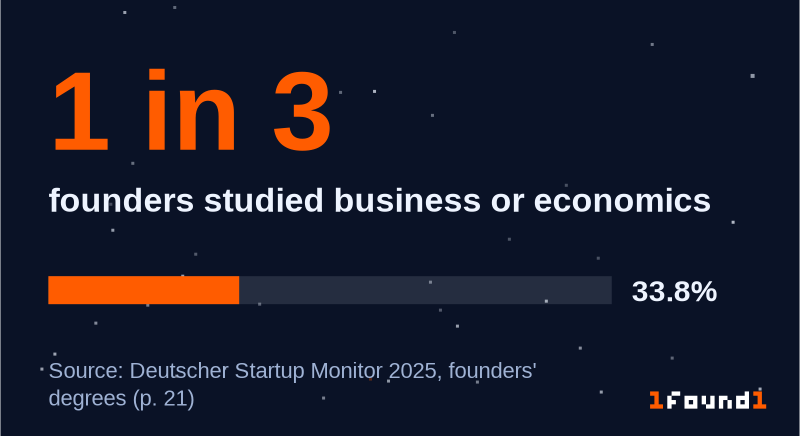
Go where people who know markets look for builders. The good news: they are not rare. In the same report, 33.8 percent of founders hold a degree in business or economics, the largest group (report p. 21).
1. A co-founder matching app like 1found1
On 1found1 you see someone's strengths and focus before their name and photo, so you can search for sales and market skills instead of a famous school. You are in the deck the day you finish your profile, send up to 10 connects a day, and set a distance slider from your city to anywhere. A note on a connect needs a LinkedIn or GitHub link, so the people who write to you have shown who they are.
2. Your customers and your industry
The person who complains most about the problem you solve may sell the fix best. Former colleagues in sales, product or consulting count too.
3. Startup events and pitch nights
Business founders go there to meet builders. You see how someone pitches and how they listen.
4. YC Co-Founder Matching
YC Co-Founder Matching is free and open to anyone looking for a co-founder. Profile approval can take up to a week, and you can send up to 15 invites a week (Startup School FAQ).
| Where | Start and limits | What you see first |
|---|---|---|
| 1found1 | Same day, 10 connects a day | Strengths and focus, name and photo after a match and a few messages |
| Your customers and industry | Whenever you ask | How they talk about the problem |
| Startup events | When an event runs | How they pitch |
| YC Co-Founder Matching | Approval can take up to a week, up to 15 invites a week | A profile, visible only to approved members |
Facts about other platforms checked on 24 November 2026.
How do you spot a strong business co-founder?
Judge what they have done, not what they say they will do. Five signs:
- They talk to customers without being asked. Ask for notes from their last five conversations.
- They can name a buyer. Who pays, how much, and why now.
- They have sold something. A product, a service, sponsorships, event tickets.
- They want to understand the product. Not "you build, I do the rest".
- They commit real hours. Full time, or a date when they will be.
Be careful with anyone who wants a large share for an idea alone, or who brings titles without results. Take the questions to your first talk: the business co-founder checklist (PDF).
How do you test a business co-founder before you commit?
Run a two-week customer sprint together. You build, they sell, and you both learn how the other works.
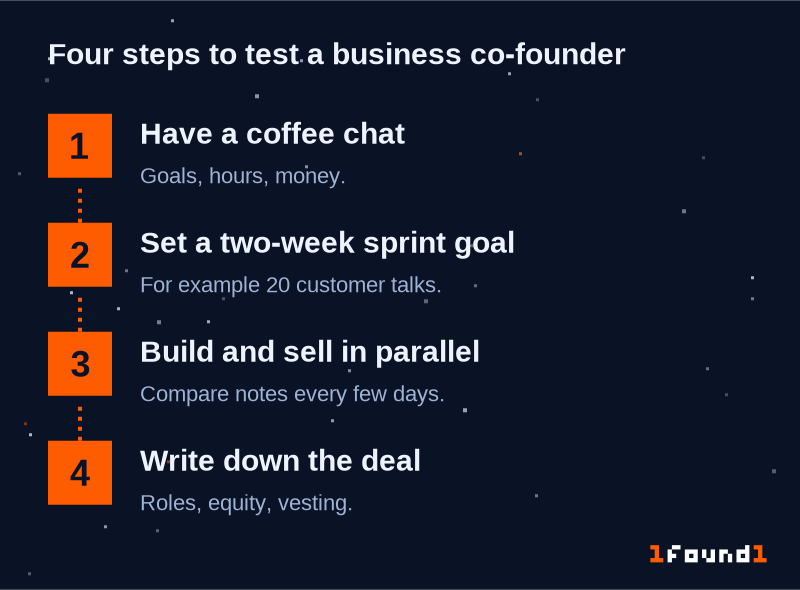
At the end, look at what came back: real conversations, a letter of intent, a paying pilot. Then talk about roles and shares, starting from our guide to a co-founder equity split.
Key takeaways
- Look for proof of selling: customer notes, closed deals, an audience.
- Search by strengths, not by school or job title.
- Keep doing sales yourself at the start, together with your co-founder.
- Run a two-week customer sprint before you discuss equity.
- Start today: enter 1found1 and look for the sales and market skills you lack.
FAQ
Should I just learn sales myself?
Learn the basics, yes: early sales are every founder's job. A co-founder adds a second person who owns customers full time, so you can keep building.
How much equity should a business co-founder get?
Start from equal and move only for big, concrete differences such as full time against part time. Protect any split with vesting.
Is an MBA a good sign?
A degree shows training, not results. Ask what they have sold, to whom, and what they learned when a deal fell through.
What if they cannot code at all?
That is fine. They should understand what the product does and what it costs to build, so you can make trade-offs together.
Can my business co-founder live in another city?
Yes, if you agree on how you work. On 1found1 the distance slider reaches from your city to anywhere, and you can start with a coffee chat in the chat.
What is your next step?
A great business co-founder brings customers, not just ideas. Write down which part of the business you need most, then go where those people are. Start on 1found1: build your profile in a few minutes and look for someone who sells.